

|
Tessera Information Management System (TIMS)
|
Deal with Bark Beetles
Bark Beetles: Did you know...? Do... & Do not…!
By Sandrine Gaillard, Ph.D., Northern Group Rio Grande Sierra Club, April 2018
- Bark beetles (Coleoptera: Curculionidae: Scolytinae) are common pests of conifers (such as pines) and some attack broadleaf trees.
- Over 600 species occur in the United States and Canada.
- They are small, cylindrical, hard-bodied insects about the size of a grain of rice.
- Most species are dark red, brown, or black.
- Natural role of bark beetles
- Canopy opening,
- Thinning,
- Diversification of stand structure and composition.
- Adult bark beetles can emerge anytime during the year, but most commonly in late spring and again in late summer to early fall.
- Bark beetles feed on trees weakened by drought, disease, injuries, or other factors that may stress the tree.
- Bark beetles can contribute to the decline and eventual death of trees. However, only a few aggressive species are known to be the sole cause of tree mortality.
- More than 20 species of bark beetles feed on weakened, dying, or dead spruce, fir, and hemlock.
- Piñon trees are attacked by a small bark beetle, the Ips confusus, called the piñon ips beetle (PIB).
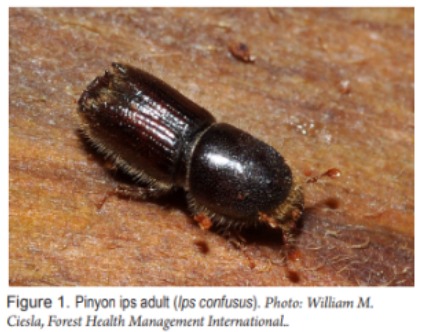
- Once present in pine trees, these bark beetles inoculate the tree with a blue stain fungus. This specific fungus is injected into the sapwood, which prevents the tree from controlling or exterminating the beetle larvae with sap. The introduction of this particular fungus blocks water and nutrient transportation within the xylem and phloem of the tree.
- Bark beetles mine the inner bark (the phloem-cambial region) on twigs, branches, or trunks of trees and shrubs.
- Small emergence holes in the bark are a good indication that bark beetles were present.
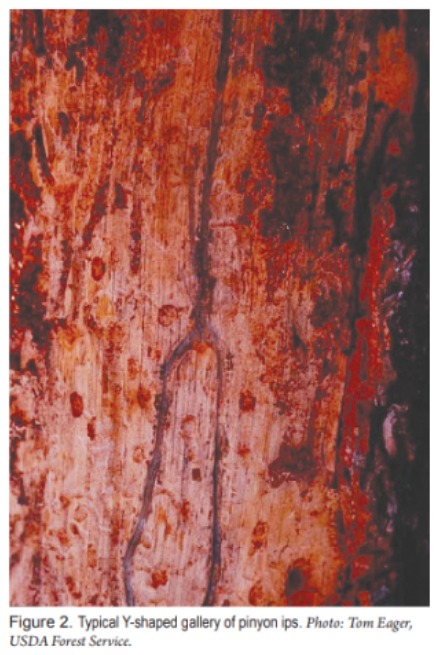
- Peeling off a portion of infested bark to reveal the winding pattern of the beetle galleries (tunnels chewed by adults and larvae) is a good way to identify individual beetle species.
- PIBs will leave a Y-shaped gallery under the bark.
- Removal of the bark with the emergence holes often reveals dead and degraded inner bark and sometimes new adult beetles that have not yet emerged.
-
Healthy trees are less likely to be attacked and are better able to survive attacks from a few bark beetles.
- Except for general cultural practices that improve tree vigor (see 10)), nothing can be done to control most bark beetles once trees have been attacked.
- Because the beetles live in the protected habitat beneath the bark, it is extremely difficult to control them with insecticides.
- In fact, there are no longer any pesticide labeled for treating beetle infested trees.
- In the case of the PIB, prevention is the only available effective control to manage them.
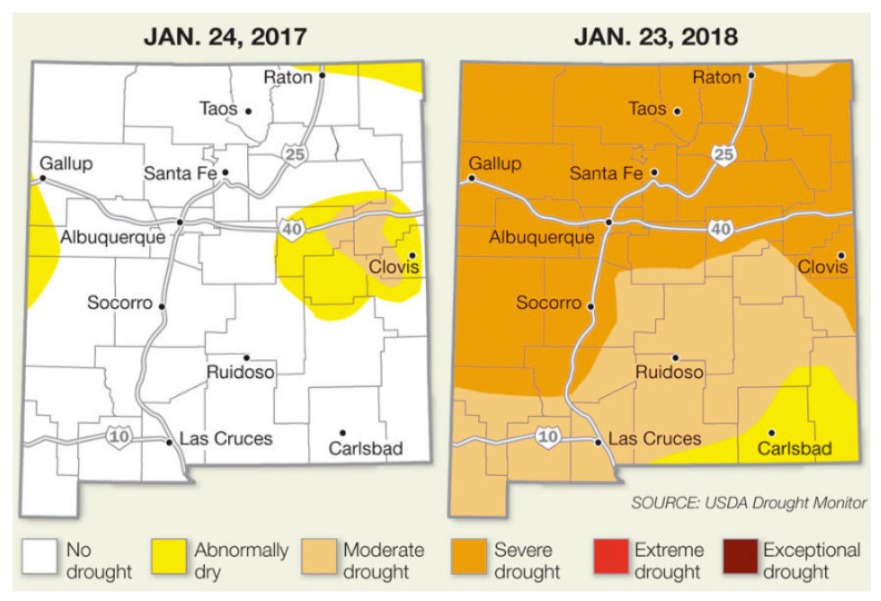
- Every time we experience drought conditions in NM, bark beetles attack.
- And bark beetles become a subject which regularly comes back among homeowners, which was the case in 2018, which is why I wrote this piece at the time.
-
As of January 23, 2018, more than 93% of New Mexico is experiencing drought conditions, according to the U.S. Department of Agriculture’s drought monitor map.
- Prevention methods
- A mixture of tree and shrub species in planted landscapes will reduce mortality resulting from bark beetles and wood borers.
- Pay particular attention to old, slow-growing trees, crowded groups of trees, and newly planted trees in the landscape.
- Dense stands of susceptible trees should be thinned (by completely removing some of the trees) to increase the remaining trees’ vigor and ability to withstand an attack.
- Tree pruning is also helpful, but timing of pruning is important.
- Avoid creating fresh pruning wounds during the adult beetles’ flight season.
- Remove mistletoe infection.
- Do not prune elm trees from March to September or pines from February to mid-October.
- Do not pile unseasoned, freshly cut green wood near woody landscape plants. Freshly cut wood and trees that are dying or have recently died provide an abundant breeding source for some wood-boring beetles.
- Irrigation is crucial during dry summer months in drought years, especially with tree species that are native to regions where summer rains are common.
- Irrigate when appropriate around the outer canopy, not near the trunk.
- Avoid the frequent, shallow type of watering that is often used for lawns.
- A general recommendation is to irrigate trees infrequently, such as twice a month during drought periods, but a sufficient amount of water must be used so that the water penetrates deeply (about 1 foot below the surface) into the soil.
- The specific amount and frequency of water needed varies greatly depending on the site, size of the tree, and whether the tree species is adapted to summer drought or regular rainfall.
- Preventive treatments must be applied by professionals to the tree trunk or branches to kill adults before they can get into the tree and lay eggs.
- Treatment following successful attacks and egg laying will not be effective.
- Insecticide products available to home users are generally not effective for bark beetle control.
- If the bark beetles have already emerged, a few tips can help save the trees that are still unattacked
- If a professional landscaper or gardener suggests that spraying a tree already showing signs of infestation is the way to go, you need to get a second opinion and most likely a new landscaper! Spraying is only preventative, and will not stop an ongoing infestation.
- After emergence, adults may re-infest the same tree or, in most cases, disperse to attack susceptible trees elsewhere.
- If trees or shrubs are infested, properly prune infested limbs, and remove and dispose of dying trees so that bark- and wood-boring insects do not emerge and attack other nearby trees.
- Never pile infested material adjacent to a live tree or shrub.
- If the main trunk is extensively attacked by bark beetles, the entire tree or shrub needs to be removed.
- Unless infested trees are cut, and infested materials are quickly removed, burned, or chipped on site, large numbers of beetles can emerge and kill nearby host trees, especially if live, unattacked trees nearby are weakened or stressed by other factors.
- References:
http://ucanr.edu/sites/sjcoeh/files/77067.pdf
https://nph.onlinelibrary.wiley.com/doi/pdf/10.1111/nph.13256
https://en.wikipedia.org/wiki/Bark_beetle
https://academic.oup.com/jipm/article/3/2/A1/877214
https://extension.arizona.edu/sites/extension.arizona.edu/files/pubs/az1394.pdf
https://www.fs.usda.gov/Internet/FSE_DOCUMENTS/stelprdb5306142.pdf
http://forestry.nv.gov/forestry-resources/forest-health/pinon-ips-neetle/
https://microbewiki.kenyon.edu/index.php/Bark_Beetles_and_Symbiotic_Fungi
| File | Uploaded | |
|---|---|---|
Pages
- Home
- Tessera Location, Maps & History
- Tessera Location
- Tessera Plat
- Tessera Hiking Trails
- Way, Way, Way Before Tessera
- Tessera's Timeline
- Tessera County Records
- Tessera Declarant
- Contacts - Tessera & Beyond
- Contact Us
- Neighborhood Interest Groups
- News, Updates & Communications
- Newsletters
- TOA Governing Documents
- Current TOA Governing Documents
- Previous TOA Governing Documents
- TOA All Meetings Minutes
- TOA Board of Directors (BOD)
- Results of TOA-BOD Prepared Surveys
- TOA Budgets & Financials
- Vendors Contracted by the TOA
- TOA Committees
- TOA Ad Hoc Committees/TaskForces
- TOA CAC - Common Areas Committee
- TOA CC - Communications Committee
- TOA CLC - Community Life Committee
- TOA DC - Design Committee
- TOA DocC - Documents Committee
- TOA FC - Finance Committee
- Tessera Sewer Coop (TSC)
- Owner's Sewer Responsibility
- TSC Monthly Financials
- How to...
- Health & Safety - How to...
- Deal with a Mental Health Emergency
- Age Independently in Tessera
- Outdoors - How to...
- Garden & Landscape in NM
- Deal with Bark Beetles
- Roads & Safety - How to...
- Slow Down Traffic
- Community Issues
- Tessera's Photos
- Tessera's Fauna
- Tessera's Amphibians & Reptiles
- Tessera's Birds
- Tessera's Mammals
- Tessera's Flora
- Tessera's Wild Plants
- Tessera's Other Plants
- Tessera's Landscapes
- Tessera's Clouds
- Tessera's Lightning
- Tessera's Rainbows
- Tessera's Sunrises
- Tessera's Sunsets
- Tessera's Parties
- 2022